
Commercial and offices
What is included in commercial cleaning?
There is no standard answer, and any provider who gives you one without asking about your building is describing a template rather than your facility. What matters is how the scope is written.
Hygiene Maids of Fort Worth7 min readUpdated
A scope document, not a checklist
Residential cleaning has a recognizable shape, so a checklist is enough. Commercial cleaning does not, because a dental practice, a distribution warehouse and a 200-seat restaurant have nothing in common except that people work in them.
What a commercial quote should produce is a scope document: which tasks, in which areas, at which frequency, during which hours, and who supplies what. The frequency part is the piece most often missing, and it is the piece that causes almost every future disagreement.
"We clean three times a week" tells you nothing about whether baseboards are included. "Restrooms and break rooms every visit; full floors twice weekly; detail dusting weekly; high dusting monthly" tells you everything, and it makes two quotes genuinely comparable.
What most commercial scopes cover
This is the common core across facility types. Everything beyond it is specific to your premises.
- Restrooms
- Toilets and urinals inside, outside, base and behind
- Partitions, latches, handles and grab rails
- Sinks, counters, taps and mirrors
- Dispensers refilled from client stock
- Floors cleaned to the wall line and behind doors
- Trash emptied and liners replaced
- Break rooms and kitchens
- Counters, sink and faucet
- Microwave inside and out
- Refrigerator exterior, handles and top
- Coffee station and the drip area
- Tables, chairs and high-touch surfaces
- Trash and recycling
- Entry and common areas
- Entry glass, both faces, and door hardware
- Reception and visitor-facing surfaces
- Waiting area seating and side tables
- Corridor floors and stair treads
- Handrails and push plates
- Elevator interiors where included
- Working areas
- Desk and counter surfaces around personal items
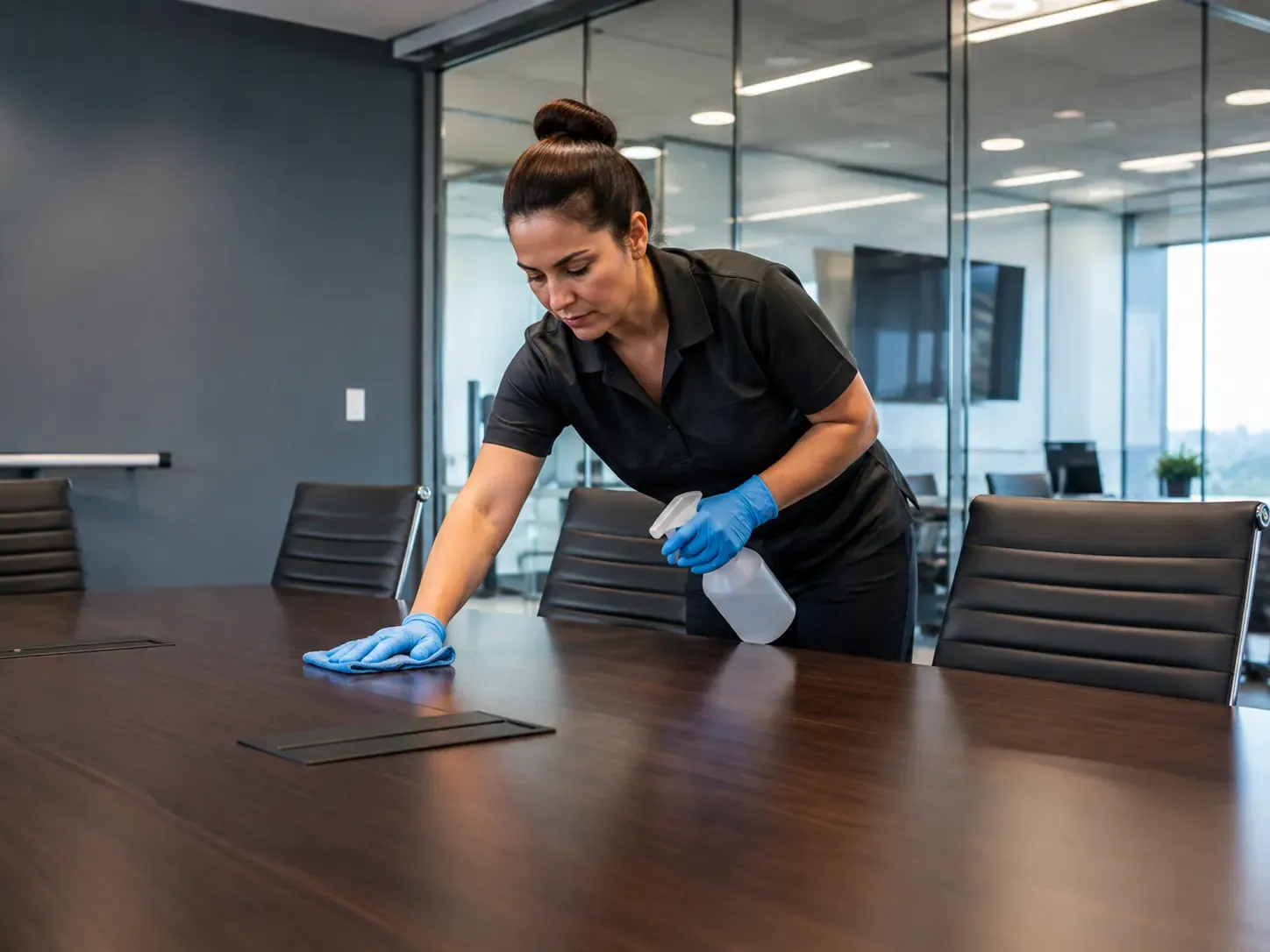
- Conference and meeting room tables
- Interior glass and partitions
- Trash and recycling at every station
- Floors vacuumed or mopped throughout
- Touch points: handles, switches, shared equipment
- Periodic detail
- Baseboards, door frames and door tops
- High dusting of vents, returns and light fixtures
- Interior window glass, sills and tracks
- Blind slats and window treatments
- Under and behind movable furniture
- Upholstery vacuuming in waiting areas
What changes by facility type
- [Offices](/commercial-cleaning/office-cleaning) — workstations, conference rooms and break rooms carry the weight; scheduled around business hours.
- [Retail](/commercial-cleaning/retail-cleaning) — entry glass and traffic-path floors dominate; fitting rooms and checkout every visit.
- [Restaurants](/commercial-cleaning/restaurant-cleaning) — nightly front-of-house reset; booth seams, table bases and floors under furniture take the time.
- [Medical offices](/commercial-cleaning/medical-office-cleaning) — waiting rooms, touch points and restrooms weighted; non-clinical space only.
- [Warehouses](/commercial-cleaning/warehouse-cleaning) — the people-space footprint matters far more than building size.
- [Schools](/commercial-cleaning/school-cleaning) — touch points and restrooms dominate; deep work happens during break periods.
The exclusions worth checking on every quote
Two quotes at similar prices frequently describe different work because of what sits outside scope.
- Kitchen exhaust hood and grease duct cleaning — a licensed specialty, not general cleaning
- Regulated clinical disinfection, terminal cleaning and medical waste handling — healthcare environmental services
- Hazardous-material remediation, asbestos, lead and mold abatement — licensed abatement contractors
- Industrial floor scrubbing with ride-on equipment, racking and elevated work — specialist equipment and permits
- Carpet extraction, floor stripping and refinishing — often quotable, but rarely in a standard scope
- Exterior windows, pressure washing and forecourt work
- Consumables — usually supplied by the client, with the cleaning company refilling dispensers
A provider who names exclusions is easier to work with
Anyone who agrees to everything on a walk-through will disappoint you in month three, or will quietly leave something undone and hope you do not check.
Clear boundaries are a feature. We tell businesses at the walk-through when something needs a different trade, because finding out at an inspection is considerably worse.
Questions
Common questions
- Who supplies paper, soap and liners?
- Usually the client, because most businesses already have supplier arrangements and preferences. The cleaning company refills dispensers from your stock as part of the visit. Confirm it, because a quote including consumables and one that does not are not comparable.
- Do commercial cleaners move things to clean under them?
- Almost never, and the agreement should say so. Cleaning around personal items, files and merchandise avoids both damage and awkward conversations.
- Is window cleaning included?
- Interior glass and partitions usually are. Exterior window cleaning is a separate trade.
- How is the scope changed later?
- In writing, as an amendment to the frequency grid. Verbal additions are how scopes drift and how disagreements start.
Get a scope, then a number
We walk the building, write a frequency grid, then quote against it. That is the only order that produces a comparable quote.