
Commercial and offices
How often should an office be professionally cleaned?
There is a simple test that settles this for most buildings, and it has nothing to do with square footage: look at a restroom at three in the afternoon.
Hygiene Maids of Fort Worth6 min readUpdated
The three signals that set frequency
Restrooms at mid-afternoon. If they look used by 3 PM, once-a-day cleaning is your floor rather than your ceiling. Restrooms are simultaneously the fastest area to deteriorate and the one staff complain about first, which makes them the single most reliable indicator in any building.
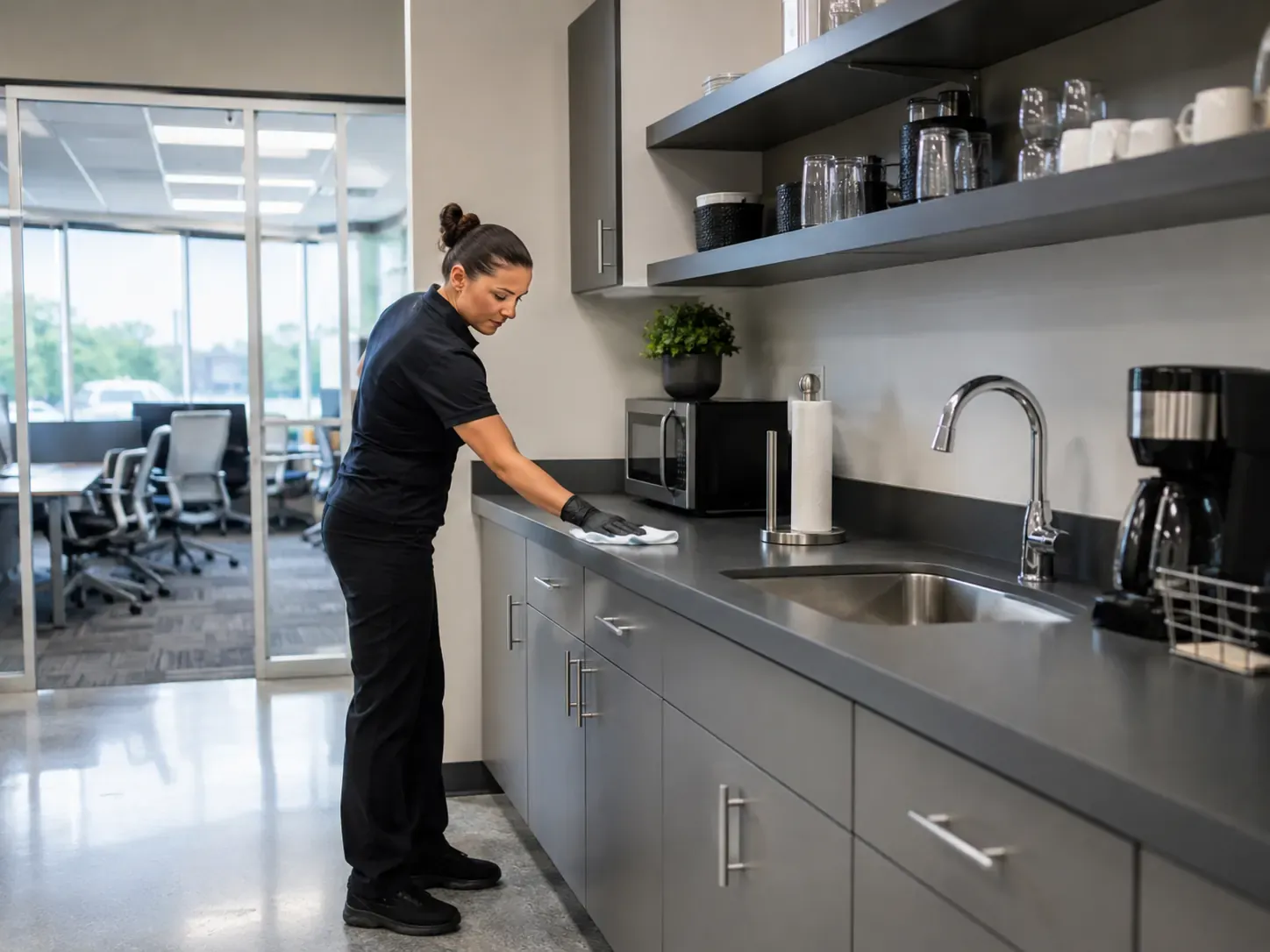
The break room by Wednesday. Shared spaces have no owner, so nobody addresses them between visits. If the sink has dishes and the microwave has a history by mid-week, the schedule is behind.
The entry floor. In North Texas an entry takes grit through dry months, mud after storms and a long pollen season that puts a visible film on hard floors within a day or two. High-traffic entries in busy buildings frequently need daily attention even when the rest of the space does not.
Throughput, not floor area
A 3,000 sq ft suite with sixty staff and two restrooms generates far more cleaning demand than a 10,000 sq ft floor with twelve people and the same two restrooms. Cleaning follows people, not walls.
That is why restroom count is usually the strongest single driver in an office quote, and headcount is second. Square footage matters for vacuuming and mopping time, but it does not tell you how fast anything deteriorates.
Visitor traffic is the third factor and it is often underestimated. A practice, an agency or any client-facing office has people moving through it who are not on the headcount, and they use the same restrooms.
A task-frequency grid that works for most offices
The efficient answer is almost never "clean everything daily." It is to stagger tasks so daily visits stay short and nothing quietly goes twelve months untouched.
- Every visit: restrooms cleaned and restocked, break room surfaces and microwave, trash and recycling, entry glass and handles, entry and high-traffic floors, reception surfaces.
- Two to three times a week: full-floor vacuuming, workstation surfaces, conference rooms, interior glass and partitions, stairwells and corridors.
- Weekly: baseboards and door frames, detail dusting of ledges and sills, chair bases and furniture legs, restroom partitions and dispensers detailed, floor edges and corners.
- Monthly or quarterly: high dusting of vents, returns and light fixtures, interior windows throughout, under and behind movable furniture, blind slats, upholstery vacuuming in waiting areas.
Typical frequency by office profile
| Point of comparison | Profile | Usual arrangement |
|---|---|---|
| Small suite, few visitors | Under about a dozen people, private or lightly used restrooms, little external traffic. | One to two visits a week, with restrooms and trash every visit. |
| Mid-size professional office | Twenty to sixty people, two or more shared restrooms, some client visits. | Three to five visits a week; restrooms, break room and entry every visit. |
| Client-facing office | Clients or the public in the space daily; reception matters constantly. | Daily, often with a mid-day restroom and reception touch-up. |
| High-density or multi-shift | High headcount relative to restroom count, or people in the building beyond normal hours. | Daily, sometimes twice, and a candidate for recurring discounts of up to 35%. |
The cheapest structure is usually split, not reduced
Offices trying to cut cleaning cost often reduce frequency across the board, which makes every visit longer and the building worse. The better lever is to keep restrooms, break rooms, trash and entry floors on every visit and stretch the rest.
That keeps the things people notice in good shape and moves the savings onto work nobody sees week to week.
Questions
Common questions
- How many employees justify daily cleaning?
- There is no clean threshold, because restroom count matters as much as headcount. The practical test is whether restrooms look used by mid-afternoon. If they do, daily is the floor.
- Can we do restrooms daily and everything else weekly?
- Yes, and it is one of the most cost-effective structures available. It is also one of the most common arrangements we set up.
- Should cleaning happen during or outside business hours?
- Most offices prefer after hours or before opening, so the work is invisible. Mid-day restroom and break room attention during operation is common in busier buildings.
- Does daily cleaning cost less per visit?
- Yes. A day of use is faster to reverse than a week of it. Total cost is still higher because there are more visits, but qualifying high-frequency schedules may attract discounts of up to 35%.
Get a frequency grid for your building
We walk the space, look at restroom count and traffic, and propose which tasks belong at which frequency.